PHYSICS / COURSE NAVIGATOR
← Course Navigator

COURSE 02 / COURSE

Dynamics

Explain motion through interaction.

OUTCOMEBuild free-body diagrams, apply Newton’s laws, and solve constrained motion with friction, drag, and changing mass.
PREREQUISITEKinematics, vectors, derivatives, and basic integration.
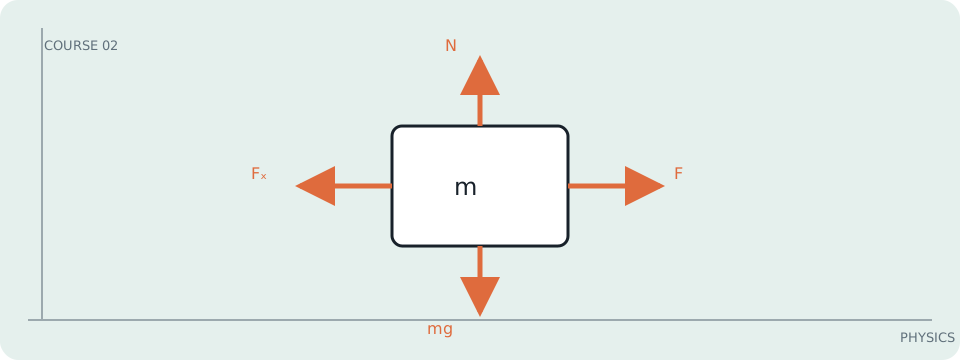
Dynamics: original course diagram
Course visual: a compact prompt for the physical ideas developed below.

12 CHAPTERS

Course map

01Force as an interactionName the interacting bodies before writing a force equation.→02Newton’s first lawRecognize inertial motion and avoid inventing forces to explain it.→03Newton’s second lawUse \(\sum \mathbf F=m\mathbf a\) as a vector accounting identity.→04Newton’s third lawPair interaction forces across bodies without canceling forces on one body.→05Free-body diagramsTurn a physical scene into a complete, auditable force model.→06Contact, normal force, and frictionModel support, static friction, kinetic friction, and their limits.→07Tension, pulleys, and constraintsUse geometry and idealized connectors to couple several bodies.→08Drag and terminal speedCompare linear and quadratic drag and identify a terminal regime.→09Circular motionExplain centripetal acceleration without treating it as a new force.→10Non-inertial framesUse centrifugal and Coriolis terms carefully when the frame demands them.→11Variable-mass systemsSee why rockets and leaks require momentum accounting, not a naive \(F=ma\).→12Dynamics studio: pump and pipe forcesEstimate support loads and reaction forces in a fountain plumbing run.→