02 / CHAPTER 04
Newton’s third law
Pair interaction forces across bodies without canceling forces on one body.
ANCHOR EQUATION
Interaction pair
In symbols: FAB = −FBA
Newton’s third-law forces act on different bodies.
Third-law pairs live on different diagrams
When hand A pushes box B, B pushes A with equal magnitude and opposite direction. The pair cannot cancel in the equation for B because A’s force acts on A, not on B.
Use an interaction graph
For an interaction between A and B, Newton’s third law gives F_AB = −F_BA. In a system containing both objects, the pair sums to zero internally. In a free-body diagram of B alone, only F_AB appears; external forces on B determine its acceleration.
A 70 kg person pushes a 10 kg cart with 35 N. The person’s acceleration from that interaction alone is 35/70 = 0.50 m/s² backward; the cart’s is 35/10 = 3.5 m/s² forward. Equal force does not imply equal acceleration because masses differ.
Action–reaction is not cause followed by delay
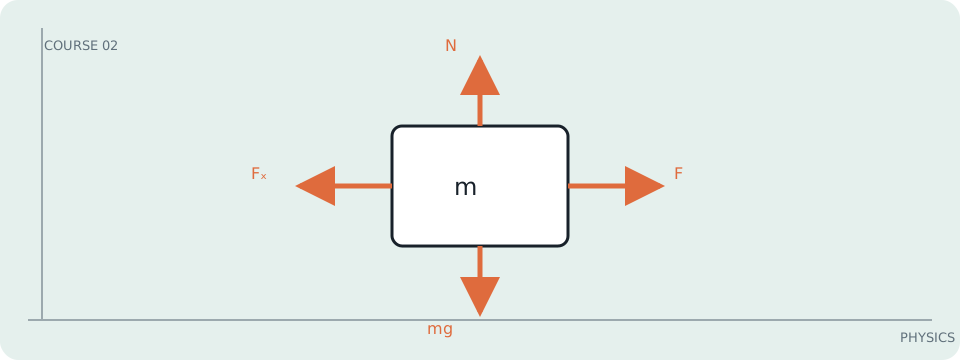
The forces arise simultaneously from the same contact interaction. Weight and normal force are not a third-law pair because they act on the same object; the partner of Earth’s gravitational pull on the book is the book’s gravitational pull on Earth.
Work it: For a swimmer pushing water backward, draw separate diagrams for swimmer and water. Identify the third-law pair and predict which object has the larger acceleration.