02 / CHAPTER 02
Newton’s first law
Recognize inertial motion and avoid inventing forces to explain it.
ANCHOR EQUATION
Inertial motion
In symbols: ΣF = 0 ⇒ v = constant
Zero net force means velocity, not merely speed, remains unchanged.
Inertia is the zero-force prediction
Newton’s first law says an inertial observer sees zero net force as constant velocity. Rest is only one special case; a coasting spacecraft and a parked book share the same dynamical condition.
Set the momentum derivative to zero
Start with ΣF = dp/dt. If ΣF = 0, then dp/dt = 0, so p is constant. For fixed mass, v is constant. The law also defines inertial frames: a frame in which force-free bodies do not spontaneously accelerate.
A 1200 kg car moving at 20 m/s has momentum 24,000 kg·m/s. If its net force is zero for 5 s, momentum remains 24,000 kg·m/s and it travels another 100 m, even though the engine may be off.
Why roads fool intuition
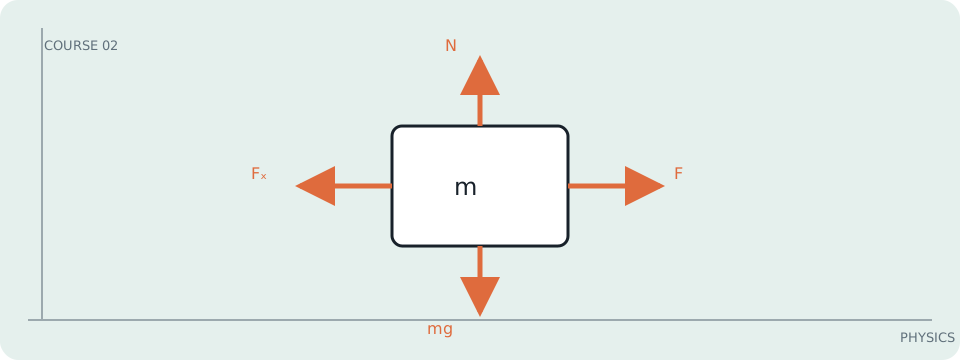
Rolling resistance and air drag are external forces, so a road vehicle does not coast forever. Friction is not evidence that motion requires a sustaining force; it is evidence that a resisting interaction was omitted from the idealized free-body diagram.
Work it: A puck slides at 4 m/s on nearly frictionless ice. Predict its velocity after 3 s, then add a 0.8 N drag force to a 0.20 kg puck and recompute the change.