02 / CHAPTER 03
Newton’s second law
Use \(\sum \mathbf F=m\mathbf a\) as a vector accounting identity.
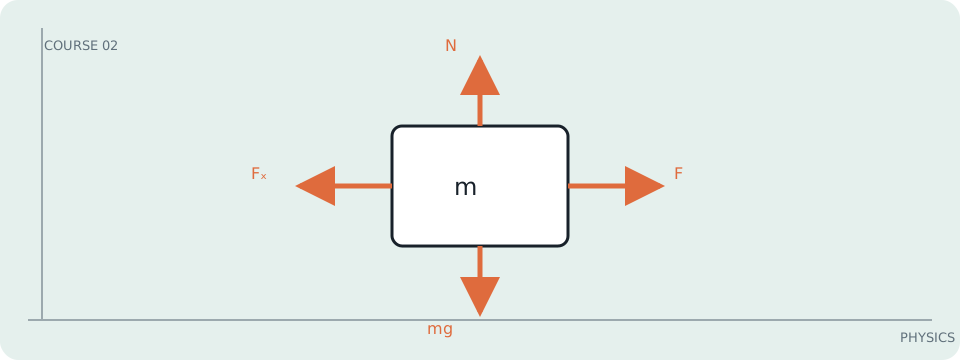
ANCHOR EQUATION
Force balance
In symbols: ΣF = ma
Draw the system boundary before summing the forces acting on the chosen body.
Newton’s second law is vector accounting
Acceleration is the response to the net external interaction, not to one selected force. The vector sum explains why perpendicular forces can produce a diagonal acceleration and why balanced forces can coexist with nonzero individual forces.
Resolve the balance into axes
For a body of mass m, ΣF = ma. Projecting onto x and y gives ΣFₓ = maₓ and ΣFᵧ = maᵧ. Choose axes, write each force component with its sign, sum, then divide by m. The direction of a follows from its components; no separate ‘force of acceleration’ is needed.
A 5 kg block has forces (12, 0) N and (−4, 9) N. The net is (8, 9) N, so a = (1.6, 1.8) m/s² and |a| = 2.41 m/s². The resultant angle is arctan(1.8/1.6) = 48.4° above +x.
Equilibrium does not mean no forces
A hanging lamp can have tension upward and weight downward, each 49 N, while acceleration is zero. If mass changes, use dp/dt rather than blindly dividing a force by an instantaneous mass.
Work it: A 10 kg crate experiences 30 N east, 18 N west, and 40 N north. Find acceleration and the distance traveled in 2 s from rest, assuming the forces stay constant.