02 / CHAPTER 01
Force as an interaction
Name the interacting bodies before writing a force equation.
ANCHOR EQUATION
Newton’s second law
In symbols: ΣF = ma
The vector accounting identity behind a free-body diagram.
A force names an interaction
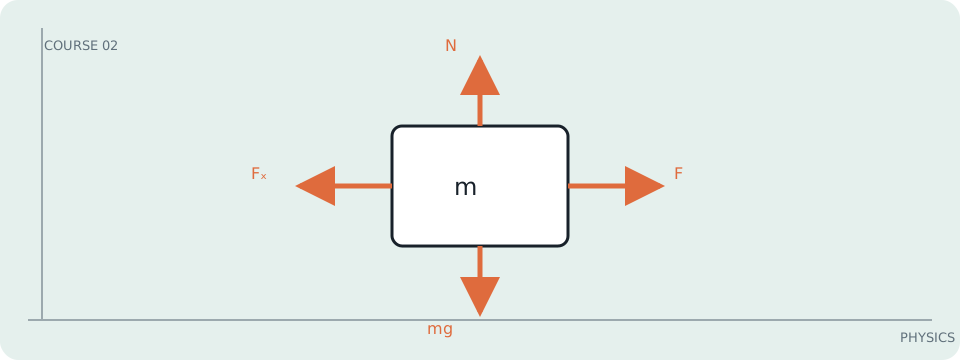
Force is not a property an object carries; it is one body’s interaction with another. A free-body diagram becomes trustworthy only after the chosen system and every external interaction are named.
Build Newton’s law from momentum
Define momentum p = mv. For constant mass, the rate of momentum change is dp/dt = m dv/dt = ma. Newton’s second law states that this rate equals the vector sum of external forces: ΣF_ext = dp/dt. Writing ΣF = ma is therefore a balance statement for the selected body, not a list of ‘forces present somewhere nearby.’
A 2.0 kg cart pulled by 6.0 N right and opposed by 1.5 N friction has ΣF = 4.5 N right, so a = 4.5/2.0 = 2.25 m/s². The units N/kg reduce to kg·m/s²/kg = m/s².
Internal forces disappear only inside a system balance
If the cart and the person are one system, their mutual push is internal and cancels in the total balance. If the cart alone is the system, the person’s push is external. Changing the system changes the bookkeeping, not the physics.
Work it: Draw a free-body diagram for a book pulled across a table. Label contact partners, choose axes, sum components, and predict acceleration for m = 3 kg, pull = 10 N, friction = 4 N.