02 / CHAPTER 06
Contact, normal force, and friction
Model support, static friction, kinetic friction, and their limits.
ANCHOR EQUATION
Static friction limit
In symbols: |fs| ≤ μsN
Static friction adapts up to a material-dependent maximum.
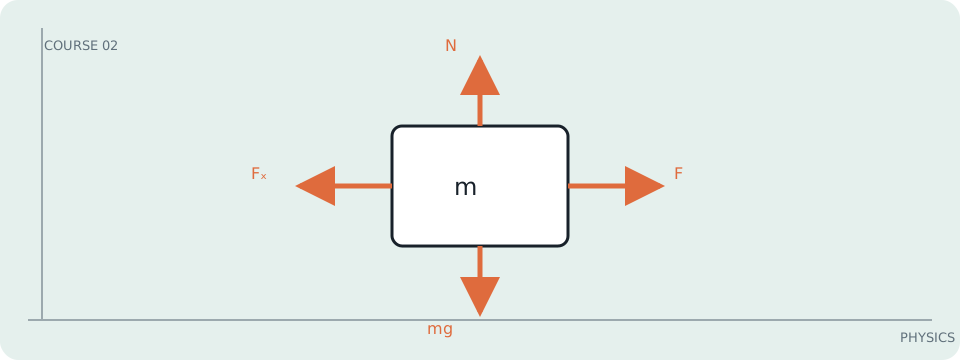
Normal force is a constraint reaction
A surface pushes perpendicular to itself just enough to prevent interpenetration, unless contact is lost. It is not automatically equal to weight; that equality is a special zero-acceleration case on a horizontal surface.
Solve the perpendicular equation first
For a block on an incline of angle θ, weight decomposes into mg cosθ normal to the plane and mg sinθ along it. If the block remains in contact and has no normal acceleration, ΣF_⊥ = N − mg cosθ = 0, giving N = mg cosθ. Kinetic friction then has magnitude f_k = μ_k N and opposes relative sliding.
For m = 5 kg, θ = 30°, μ_k = 0.20: N = 5(9.81)cos30° = 42.5 N; f_k = 8.50 N; downhill net force = 24.5 − 8.50 = 16.0 N; a = 3.20 m/s².
Static friction is a range, not a fixed value
Static friction satisfies |f_s| ≤ μ_sN and takes whatever value prevents slipping. If the required value exceeds μ_sN, contact still exists but sliding begins and the kinetic model replaces it.
Work it: A 10 kg box rests on a 25° incline with μ_s = 0.50. Compare mg sin25° with μ_s mg cos25° and decide whether it slips; do not assume f_s = μ_sN before testing the inequality.