← Course Navigator
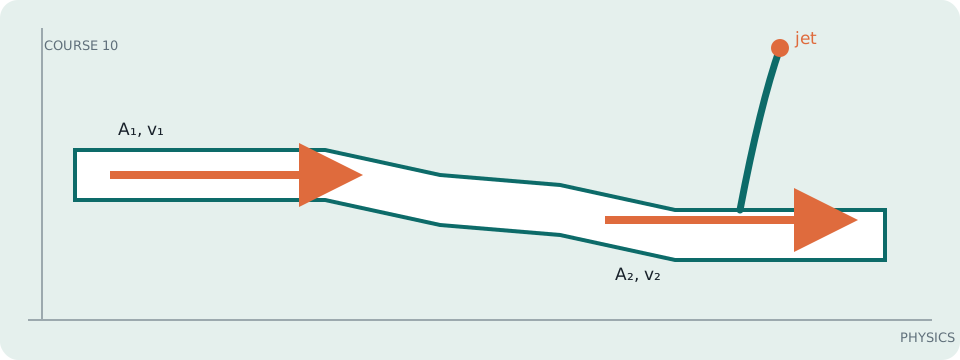 Course visual: a compact prompt for the physical ideas developed below.
01Fluid properties and pressureDefine density, viscosity, compressibility, and pressure for a fluid model.→02Hydrostatics and buoyancySolve fluids at rest and connect pressure variation to weight.→03Control volumes and continuityTrack mass through pipes, nozzles, tanks, and moving boundaries.→04Bernoulli and mechanical energyUse pressure, elevation, and speed while naming every loss assumption.→05Momentum in a flowing control volumeCalculate jet reactions, bends, and support loads.→06Viscous pipe flowDerive the balance behind laminar pressure drop and Poiseuille flow.→07Boundary layers and separationSee how wall friction, adverse pressure gradients, and detachment arise.→08Dimensional analysis and similarityUse Reynolds and other dimensionless groups to transfer insight between scales.→09Vorticity, circulation, and potential flowDescribe rotation in a fluid and identify useful idealizations.→10The Navier–Stokes equationsAssemble mass, momentum, pressure, viscosity, and body-force terms in local form.→11Turbulence, averaging, and modelingUnderstand why the exact equations can still require closure assumptions.→12Fluid studio: a fountain systemMove from measurements to a defensible model of basin, pump, pipe, nozzle, and display.→