10 / CHAPTER 06
Viscous pipe flow
Derive the balance behind laminar pressure drop and Poiseuille flow.
ANCHOR EQUATION
Poiseuille flow
In symbols: Q = πR⁴Δp/(8μL)
Laminar pipe flow is exceptionally sensitive to radius.
A flowing control volume changes momentum
A bend, nozzle, or jet exerts force because the outgoing momentum vector differs from the incoming one. Pressure and weight forces must be included with momentum flux.
Integrate Newton’s law for steady flow
For a fixed control volume, ΣF_ext = ∫_out ρu(u·n)dA − ∫_in ρu(u·n)dA. For uniform inlet and outlet sections this becomes ΣF = ṁ(v_out − v_in), with ṁ = ρQ. Solve vector components separately, then reverse the reaction to obtain the force on the device.
For Q = 0.005 m³/s, ρ = 998 kg/m³, and a 90° bend changing (4,0) to (0,4) m/s, ṁ = 4.99 kg/s and momentum change is (−19.96,19.96) N; magnitude 28.2 N before pressure and weight terms.
Pressure forces can dominate
A high-pressure inlet contributes pA even when the speed is modest. Gauge pressures simplify only when atmospheric forces cancel across all exposed sections.
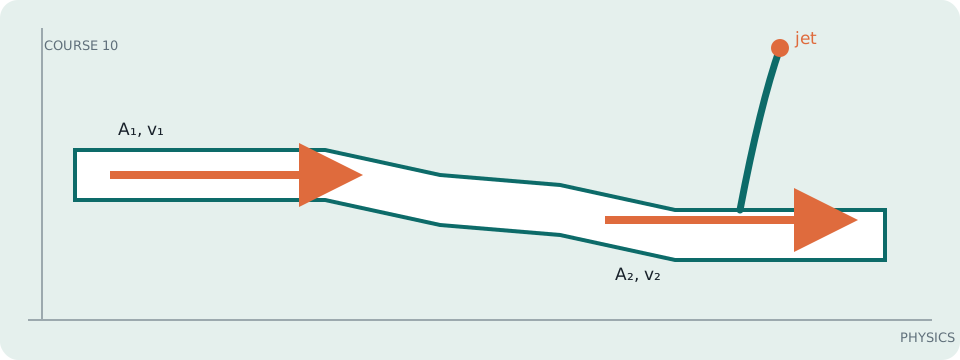
Work it: A horizontal reducer changes water velocity from 3 to 12 m/s with ṁ = 2 kg/s. Find momentum-force change. State the inlet and outlet gauge pressures needed to finish the wall-force calculation.