10 / CHAPTER 05
Momentum in a flowing control volume
Calculate jet reactions, bends, and support loads.
ANCHOR EQUATION
Control-volume momentum
In symbols: ΣF = ṁ(vout − vin)
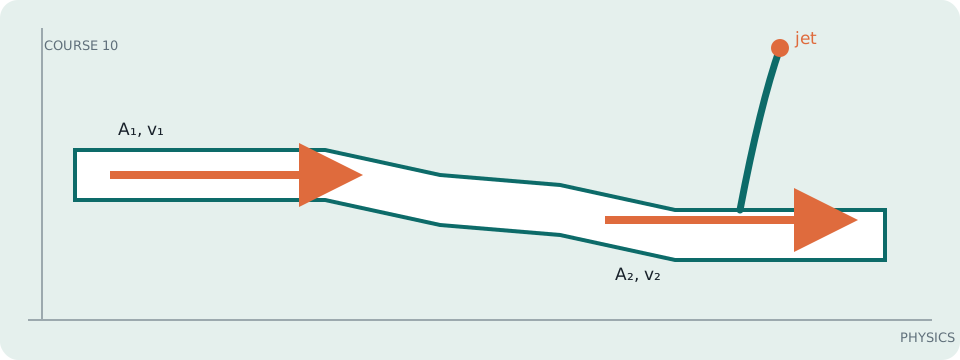
The force on a jet, bend, or nozzle follows from momentum flux change.
Bernoulli is an energy balance along an ideal streamline
Pressure, kinetic energy per volume, and gravitational potential per volume can exchange as a fluid moves. Bernoulli is powerful because it compresses a force-and-energy argument, but every omitted loss is an assumption.
Derive the ideal relation
For a small fluid parcel of volume dV moving distance ds along a streamline, pressure work is (p₁ − p₂)dV, gravity work is ρg(z₁ − z₂)dV, and kinetic-energy change is ½ρdV(v₂² − v₁²). Set work equal to kinetic-energy change, divide by dV, and rearrange: p + ½ρv² + ρgz = constant. Add pump head and subtract losses for real systems.
Water exits a reservoir at p₁ = p₂ atmospheric, v₁ ≈ 0, and drops 2 m to a nozzle. Ideal speed satisfies ½ρv² = ρg(2), so v = √39.24 = 6.26 m/s.
Viscosity breaks the constant
Pipe friction, valves, bends, turbulence, and pumps add or remove mechanical energy. Bernoulli can still be used between points if a measured or modeled head-loss term is included.
Work it: A nozzle is 1.5 m above a reservoir and has 0.8 m head loss. Find ideal and corrected exit speeds, assuming both points are atmospheric and reservoir speed is negligible.