10 / CHAPTER 12
Fluid studio: a fountain system
Move from measurements to a defensible model of basin, pump, pipe, nozzle, and display.
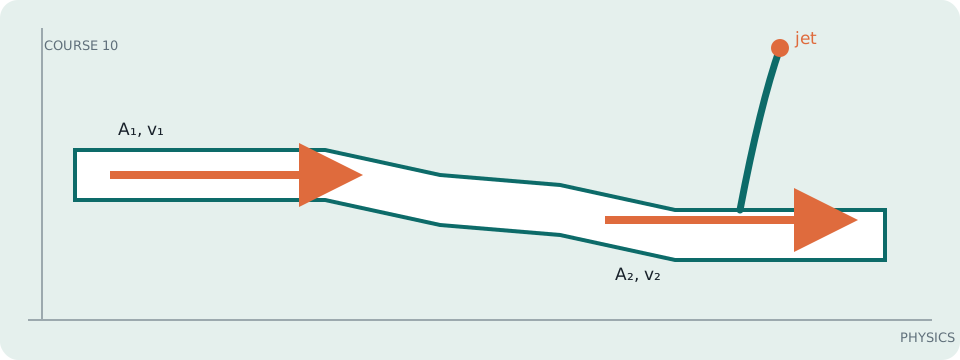
ANCHOR EQUATION
Fountain flow rate
In symbols: Q = Av = πd²v/4
A measured nozzle diameter and jet speed provide a first flow-rate estimate.
Turbulence creates a closure problem
Turbulent velocity contains organized mean motion plus fluctuations across many scales. Averaging the exact equation introduces correlations of fluctuations, so knowing the mean velocity is not enough to compute the mean stress.
Average the nonlinear term
Write u = ū + u′ with average u′ = 0. The nonlinear advection average is overline(u·∇u) = ū·∇ū + ∇·overline(u′u′) under incompressibility. The new tensor overline(u′u′) acts like a turbulent momentum flux and is unknown without a model.
If rms fluctuation speeds are 0.2 m/s in water, the scale of turbulent stress ρ overline(u′²) is about 998(0.04) = 40 Pa. This can exceed molecular viscous stress in a weak-gradient region.
Averaging loses information by design
Long-time averaging can hide coherent vortices and intermittent bursts. A Reynolds-averaged model predicts mean behavior only to the extent its closure, wall treatment, and calibration apply.
Work it: For a mean speed 2 m/s and fluctuation rms 0.1 m/s, estimate turbulent-to-mean kinetic-energy ratio using ½u′²/½ū². Explain why a small ratio can still alter wall stress.