10 / CHAPTER 03
Control volumes and continuity
Track mass through pipes, nozzles, tanks, and moving boundaries.
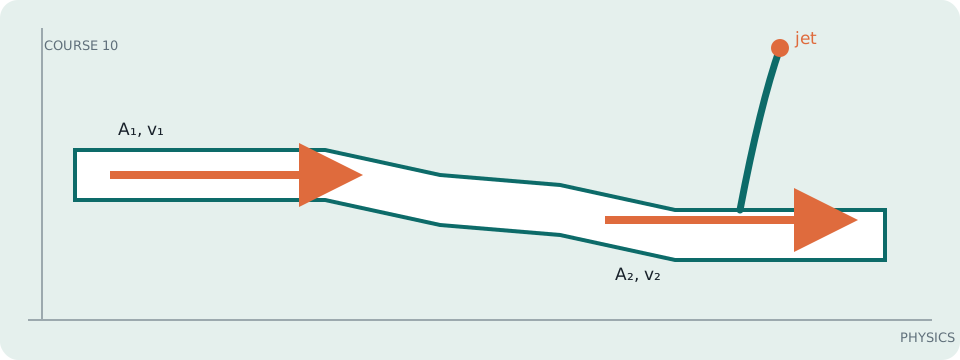
ANCHOR EQUATION
Continuity
In symbols: Q = Av
For steady incompressible flow, smaller area means greater average speed.
Buoyancy is a pressure-gradient result
An immersed body is pushed more strongly from below than above because pressure increases with depth. The upward force equals the weight of displaced fluid, regardless of the body’s material.
Sum pressure forces on the body
For a small volume element, pressure force is −∇p dV. Hydrostatic equilibrium gives ∇p = −ρ_f g, so pressure force on a displaced volume V is ρ_f g V upward. This is buoyant force F_B = ρ_f g V_displaced. Compare it with object weight ρ_o g V to predict float, sink, or neutral suspension.
A 0.010 m³ object displaces water, so F_B = 998(9.81)(0.010) = 97.9 N. If its mass is 8 kg, weight is 78.5 N and net upward force is 19.4 N before acceleration and drag.
Floating adjusts displaced volume
A floating object displaces exactly enough fluid for F_B = mg; it need not be fully submerged. Compressibility, trapped air, and fluid density change the displaced volume required.
Work it: An object of mass 12 kg and volume 0.020 m³ is placed in water. Determine whether it floats, its submerged volume if it does, and the fraction submerged.