10 / CHAPTER 04
Bernoulli and mechanical energy
Use pressure, elevation, and speed while naming every loss assumption.
ANCHOR EQUATION
Bernoulli equation
In symbols: p + ½ρv² + ρgz = constant
Pressure, speed, and elevation exchange energy along an ideal streamline.
SCRATCH-PAPER LAB
Change one parameter; watch the prediction move.
Give the water more elevation head or add losses. The ideal nozzle speed follows v = √(2gH); losses subtract from the available head.
Continuity tracks mass through a control volume
A control volume is a region in space that fluid crosses. Steady flow does not mean equal speeds; it means the mass stored in the chosen region is not changing while inlet and outlet fluxes balance.
Derive the area–speed relation
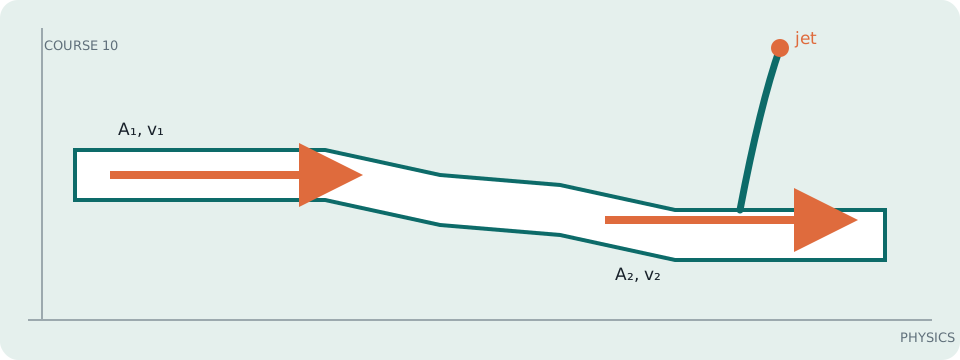
Mass flux through area A is ρu_n A. Steady conservation gives Σ_in ρu_nA = Σ_out ρu_nA. For one incompressible stream with constant ρ, ρA₁v₁ = ρA₂v₂, so Q = Av is constant. The smaller area requires larger average speed.
A pipe contracts from diameter 40 mm to 20 mm. Area falls by four, so a 2 m/s inlet becomes 8 m/s at the outlet. If Q = A₁v₁ = π(0.04²)/4·2 = 0.00251 m³/s.
Steady and incompressible are separate assumptions
A filling tank is unsteady; a gas nozzle may be compressible; a leaking or branching system needs all boundary fluxes. Use ρQ for mass flow when density changes.
Work it: A 30 mm pipe carries 0.003 m³/s into a 10 mm nozzle. Calculate both mean speeds and mass flow rate for water at 998 kg/m³.