← Course Navigator
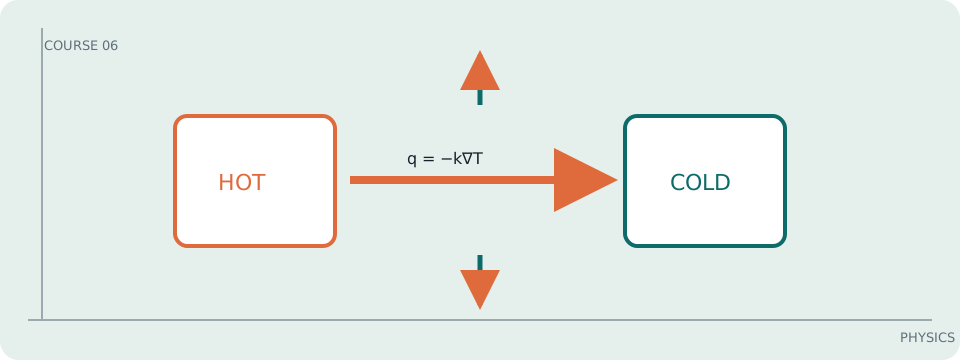 Course visual: a compact prompt for the physical ideas developed below.
01Temperature and thermal equilibriumDefine what a thermometer measures and when temperature is transferable.→02The ideal gas modelRelate pressure, volume, temperature, and amount of gas.→03Kinetic theoryConnect microscopic molecular motion to macroscopic pressure.→04Heat, work, and internal energySeparate energy transfer modes in the first law.→05Processes on state diagramsRead isobaric, isochoric, isothermal, and adiabatic paths.→06Heat capacity and phase changeCalculate storage and latent-energy requirements.→07Entropy and the second lawUse entropy to mark directionality and unavailable work.→08Heat engines and refrigeratorsCompare cycles by coefficient of performance and efficiency.→09Conduction, convection, and radiationClassify heat transport and choose an appropriate model.→10Diffusion and random walksSee transport as the macroscopic result of microscopic steps.→11Dimensionless thermal groupsUse Reynolds, Prandtl, and Nusselt numbers as regime clues.→12Thermal studio: warming a basinEstimate heating, evaporation, and environmental losses in a water feature.→