06 / CHAPTER 01
Temperature and thermal equilibrium
Define what a thermometer measures and when temperature is transferable.
ANCHOR EQUATION
Temperature scale
In symbols: T = θ + 273.15 K
Absolute temperature is the scale used in thermodynamic ratios.
Temperature is an equilibrium reading
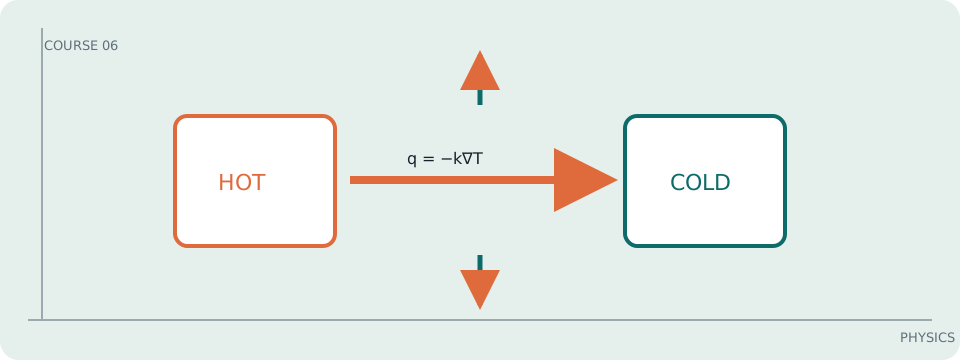
Temperature is the state variable that determines the direction of spontaneous thermal exchange: energy flows from higher temperature to lower temperature when systems can interact. A thermometer reaches equilibrium with what it measures; it does not read ‘heat content.’
Build an absolute scale
A temperature difference is independent of the zero point, but ratios in thermodynamics require an absolute scale. Celsius and kelvin have equal-sized increments, with T_K = θ_C + 273.15. Absolute zero is the extrapolated limit where the ideal-gas pressure or volume trend reaches zero, not a convenient arbitrary origin.
A room at 22°C is 295.15 K. A 10 K increase is the same size as a 10°C increase, but 22 K is not ‘22°C above absolute zero’; it is −251.15°C.
Thermal equilibrium is not equal energy
Two objects at the same temperature can contain very different internal energies because energy also scales with mass, material, and phase. A thermometer’s small thermal mass reduces disturbance but never makes it zero.
Work it: A 100 g thermometer at 20°C is placed in 1 kg of water at 60°C. Predict the thermometer reading direction and explain why equal final temperature does not imply equal energy initially.