06 / CHAPTER 07
Entropy and the second law
Use entropy to mark directionality and unavailable work.
ANCHOR EQUATION
Entropy change
In symbols: ΔS = ∫δQrev/T
Entropy provides a state measure of reversible heat transfer.
Entropy counts directionally available energy
The second law distinguishes energy conservation from reversibility. Entropy measures how energy disperses among microscopic possibilities; an isolated system’s entropy does not decrease in a spontaneous process.
Define entropy through reversible heat
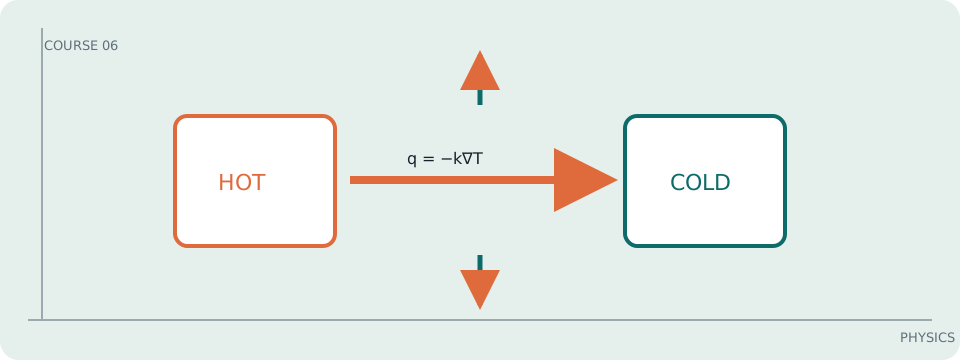
For a reversible path, dS = δQ_rev/T. If a reservoir at T supplies heat Q reversibly, ΔS = Q/T. For two bodies exchanging Q from hot T_h to cold T_c, total entropy change is Q(1/T_c − 1/T_h) > 0 when T_h > T_c. The inequality encodes the preferred direction.
Transferring 1000 J from 400 K to 300 K gives ΔS_total = 1000(1/300 − 1/400) = 0.833 J/K. The energy is conserved, but the reverse transfer would require work.
Entropy is not ‘disorder’ in every useful calculation
Entropy is a state function and can be computed for reversible reference paths even when the actual process is irreversible. The real process has the same endpoint ΔS but produces entropy internally.
Work it: A 2 kg block with c = 900 J/(kg·K) cools reversibly from 350 K to 300 K. Integrate dS = mc dT/T and calculate ΔS; state its sign.