06 / CHAPTER 09
Conduction, convection, and radiation
Classify heat transport and choose an appropriate model.
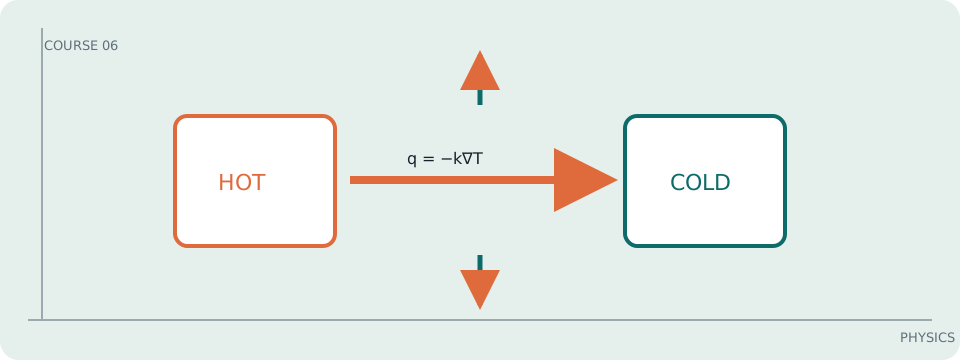
ANCHOR EQUATION
Fourier conduction
In symbols: q = −k∇T
Heat flux points down the temperature gradient.
Heat chooses a transport mechanism
Conduction moves energy through microscopic interactions, convection carries energy with bulk fluid motion, and radiation transports electromagnetic energy without needing a material medium. The right equation follows the dominant mechanism.
Write the local flux laws
Conduction is q⃗ = −k∇T, where k is thermal conductivity and q⃗ is heat flux. For a surface exchanging with moving fluid, convection is Q̇ = hA(T_s − T_∞). Thermal radiation from an idealized surface is Q̇ = εσA(T⁴_s − T⁴_sur). The different powers of temperature and gradients are physical signatures of different mechanisms.
A wall with k = 0.8 W/(m·K), area 2 m², thickness 0.04 m, and ΔT = 20 K conducts Q̇ = kAΔT/L = 800 W. Doubling thickness halves the loss in the one-dimensional model.
Do not add mechanisms without a boundary
Conduction, convection, and radiation may act in series or parallel. A hot surface’s temperature is not automatically the fluid temperature; contact resistance and boundary layers can dominate.
Work it: Estimate radiative loss from a 1 m² black surface at 350 K to surroundings at 300 K using σ = 5.67×10⁻⁸ W/(m²K⁴). Compare with a convective coefficient h = 10 W/(m²K).