06 / CHAPTER 10
Diffusion and random walks
See transport as the macroscopic result of microscopic steps.
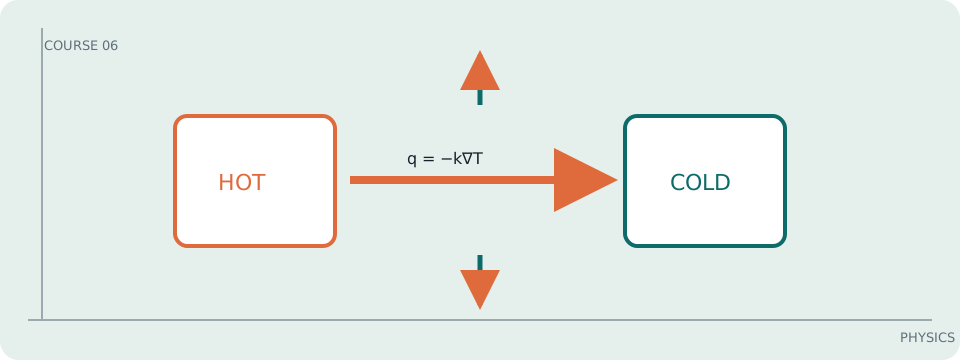
ANCHOR EQUATION
Thermal diffusion
In symbols: ∂T/∂t = α∇²T
Diffusion smooths temperature differences over time.
Diffusion is a random walk seen at large scale
Individual molecular steps are directionally random, but the mean-square displacement grows because variances add. This produces smooth macroscopic transport from microscopic motion.
Count independent steps
After N steps of length ℓ with random directions, the mean displacement is near zero but mean-square displacement is ⟨x²⟩ = Nℓ² in one dimension. If each step takes τ, time t = Nτ, so ⟨x²⟩ = (ℓ²/τ)t = 2Dt with D = ℓ²/(2τ). The diffusion equation ∂c/∂t = D∂²c/∂x² has the same spreading scale √(Dt).
If D = 1×10⁻⁹ m²/s, the one-dimensional rms distance after 1000 s is √(2Dt) = 1.41 mm. Molecular mixing across centimetres therefore takes much longer without convection.
Diffusion is not instantaneous mixing
The diffusion equation has infinite mathematical tails, but practical concentration changes over a distance L occur on t_diff ~ L²/D. Increasing length by ten makes diffusion time about one hundred times longer.
Work it: Compare diffusion times across 1 mm and 1 cm for D = 10⁻⁹ m²/s. Then explain why stirring a basin is so effective.