PHYSICS / COURSE NAVIGATOR
← Course Navigator

COURSE 01 / COURSE

Kinematics

Describe motion cleanly before explaining it.

OUTCOMERepresent position, velocity, and acceleration in one and several dimensions, and connect graphs, vectors, and calculus.
PREREQUISITEComfort with algebra, graphs, and basic trigonometry.
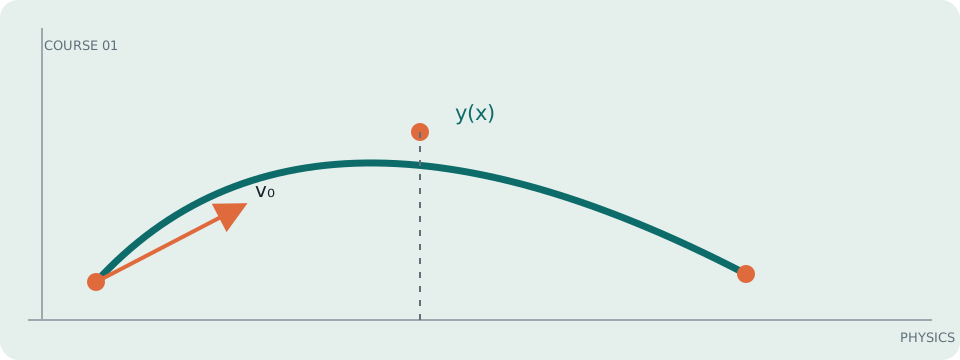
Kinematics: original course diagram
Course visual: a compact prompt for the physical ideas developed below.

12 CHAPTERS

Course map

01Position, time, and reference framesChoose coordinates and describe an event without smuggling in a preferred observer.→02Displacement and average velocitySeparate where an object is from how far it traveled and how fast the change occurred.→03Instantaneous velocityRead the tangent of a position–time curve and make the derivative physically meaningful.→04Acceleration as changing velocityTreat acceleration as a vector change, not merely as speeding up.→05Constant-acceleration motionDerive the familiar one-dimensional equations and know the assumptions behind them.→06Free fall and gravity near EarthModel vertical motion while keeping sign conventions and neglected effects explicit.→07Vectors and componentsTurn a two- or three-dimensional motion into coupled scalar problems.→08Projectile motionCombine independent horizontal and vertical motion into a trajectory.→09Relative motionTranslate position, velocity, and acceleration between moving frames.→10Polar and path coordinatesDescribe curved motion with radial and tangential pieces.→11Graphs, data, and uncertaintyUse measurements to infer motion while reporting resolution and uncertainty honestly.→12Kinematics studio: fountain trajectoriesAnalyze a jet arc from video or field measurements and defend the model.→