01 / CHAPTER 06
Free fall and gravity near Earth
Model vertical motion while keeping sign conventions and neglected effects explicit.
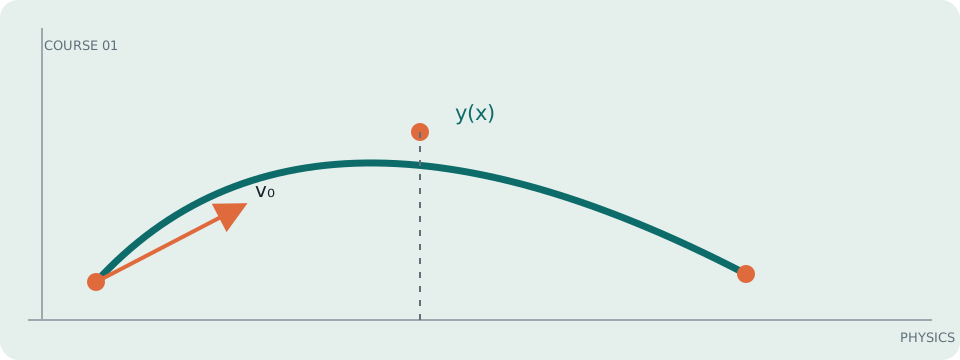
ANCHOR EQUATION
Free fall
In symbols: y = y₀ + v₀t − ½gt²
Near Earth, gravity supplies an approximately constant downward acceleration g.
Free fall is a force model
Near Earth, gravity gives objects a downward acceleration that is nearly constant when height changes are small compared with Earth’s radius and air resistance is negligible. The minus sign comes from choosing upward as positive, not from gravity being ‘negative’ in all coordinate systems.
Insert the gravitational acceleration
With y upward, a_y = −g where g ≈ 9.81 m/s². Substituting into the constant-acceleration result gives v_y = v₀y − gt and y = y₀ + v₀y t − ½gt². The same equations work for a dropped object (v₀y = 0) or a thrown object; the initial velocity carries the launch information.
A stone is thrown upward at 14.0 m/s. At the apex v = 0, so 0 = 14.0 − 9.81t gives t = 1.43 s. The rise is Δy = 14.0(1.43) − ½(9.81)(1.43²) ≈ 10.0 m. The downward trip is symmetric only because the launch and landing heights match.
Air makes the motion asymmetric
A feather and a coin do not share the same acceleration in air because drag depends on shape and speed. In vacuum, mass cancels from F_g = mg = ma, giving a = g; that cancellation is the physical content of the idealization.
Work it: From a 20 m balcony, launch a ball downward at 3.0 m/s. Solve the quadratic for impact time and speed, and state which root is physically meaningful.