01 / CHAPTER 08
Projectile motion
Combine independent horizontal and vertical motion into a trajectory.
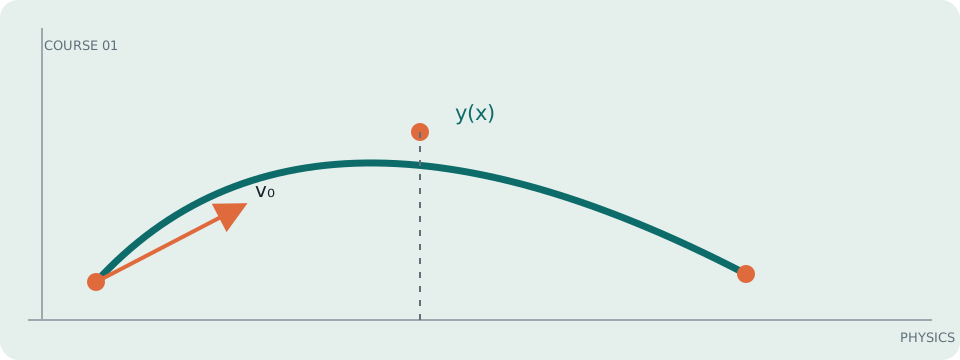
ANCHOR EQUATION
Projectile path
In symbols: y = x tanθ − gx²/(2v₀²cos²θ)
Horizontal and vertical motion combine into a parabolic trajectory when drag is neglected.
SCRATCH-PAPER LAB
Change one parameter; watch the prediction move.
Drag the launch speed and angle. The curve is the ideal trajectory y = x tanθ − gx²/(2v₀²cos²θ); the readouts expose the assumptions instead of hiding them.
A projectile is two motions sharing one clock
Ignoring drag, gravity has no horizontal component, so horizontal velocity stays constant while vertical velocity changes at −g. The trajectory is curved because the two component motions are combined at the same time t.
Eliminate time
For launch speed v₀ at angle θ, x = v₀ cosθ·t and y = v₀ sinθ·t − ½gt². From the first relation, t = x/(v₀ cosθ). Substitute it into y: y = x tanθ − [g x²]/[2v₀² cos²θ]. The x² term makes the path a parabola; it is not an extra law, only the result of eliminating the shared clock.
A jet leaves at 8.0 m/s and 40°. At x = 2.0 m, t = 2/(8 cos40°) = 0.326 s and y = 8 sin40°(0.326) − ½(9.81)(0.326²) ≈ 1.48 m above the nozzle.
The ideal arc has a domain
The model assumes a point launch, constant g, level landing if using range formulas, and negligible drag. A nozzle’s finite diameter, air drag, and wind alter the measured arc; compare residuals from video before trusting fitted parameters.
Work it: For v₀ = 10 m/s and θ = 35°, calculate time of flight and range for equal launch and landing heights. Then predict how range changes at θ = 55° and explain the symmetry.