01 / CHAPTER 04
Acceleration as changing velocity
Treat acceleration as a vector change, not merely as speeding up.
ANCHOR EQUATION
Acceleration
In symbols: a = dv/dt = d²x/dt²
Acceleration measures how velocity changes, including changes of direction.
Acceleration changes the velocity vector
An object accelerates whenever its velocity changes in magnitude or direction. A car moving at constant speed around a bend accelerates because its velocity vector rotates even though the speedometer does not change.
Differentiate velocity
Define acceleration over a short interval as Δv/Δt. Taking the limit gives a(t) = dv/dt = d²x/dt² in one dimension. For a velocity vector, the same definition applies component by component: a = (dvₓ/dt, dvᵧ/dt, dv_z/dt). The direction of a tells how v is being redirected.
If v(t) = (6 − 2t, 3t) m/s, then a = (−2, 3) m/s². At t = 1 s, v = (4, 3) m/s; the dot product v·a = 4(−2) + 3(3) = 1 m²/s³ is positive, so speed is increasing slightly.
Speed versus velocity
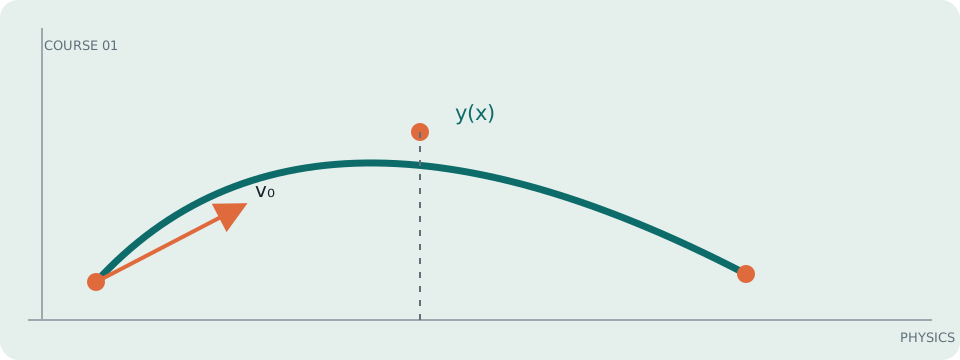
Acceleration opposite velocity reduces speed; acceleration perpendicular to velocity changes direction without instantaneously changing speed. The shortcut ‘acceleration means speeding up’ fails in circular motion and at the top of a projectile’s flight.
Work it: A particle has v = (0, 5) m/s and a = (−4, 0) m/s². Is its speed initially changing? Predict the direction of its path one second later using a first-order velocity estimate.