07 / CHAPTER 03
Electric potential and energy
Use scalar potential to solve field and energy questions efficiently.
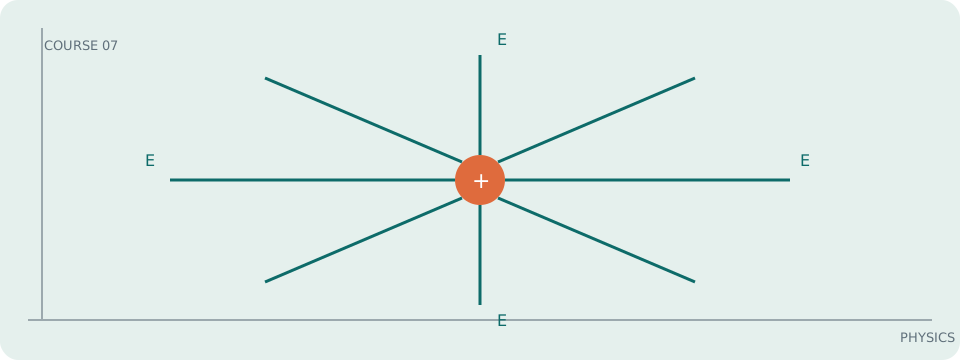
ANCHOR EQUATION
Electric potential
In symbols: E = −∇V
Electric field points toward decreasing electric potential.
Potential is energy per charge
Electric potential V is a scalar measure of potential energy available per unit charge. Scalars often make multi-source problems easier because potentials add before the field is recovered by a gradient.
Integrate the field along a path
For a small displacement, dU = −F·dr = −qE·dr, so dV = dU/q = −E·dr. For a point charge with E = kQ/r² r̂, integrate from infinity to r: V(r) = −∫∞^r E·dr = kQ/r. The field points toward decreasing potential: E = −∇V.
A +2 μC charge at 0.50 m gives V = 8.99×10⁹(2×10⁻⁶)/0.50 = 35.96 kV relative to infinity. Bringing a +1 nC charge there raises its potential energy by qV = 35.96 μJ.
Zero potential is a reference choice
Only potential differences affect force and energy changes. Setting V = 0 at infinity is convenient for localized charges; in circuits, ground is a chosen reference node.
Work it: Two charges +3 μC at 0 and −1 μC at 0.40 m: calculate potential at the midpoint. Then decide the direction of the electric field there.