07 / CHAPTER 04
Gauss’s law
Exploit symmetry to calculate electric fields.
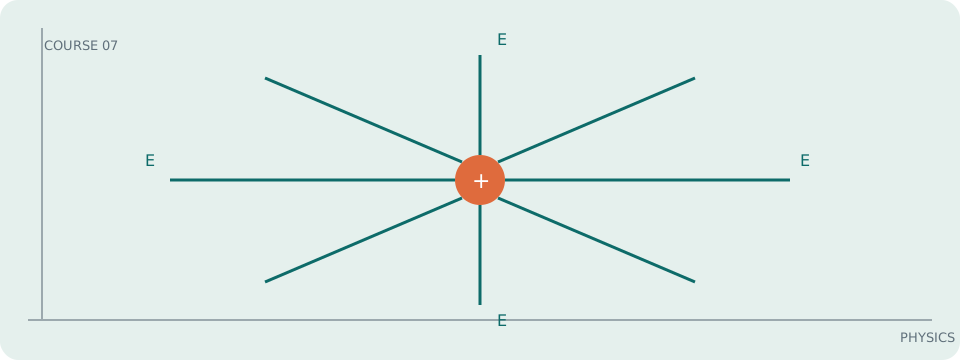
ANCHOR EQUATION
Gauss’s law
In symbols: ∮E·dA = Qenc/ε₀
Symmetry turns a field integral into a charge-enclosure relation.
Gauss’s law counts enclosed source
Electric flux measures how much field pierces a surface. Gauss’s law is always true, but it becomes a calculation shortcut only when symmetry makes E constant or predictably oriented over the surface.
Use a closed-surface balance
The flux through a small area is E·dA. Summing over a closed surface gives ∮E·dA = Q_enc/ε₀. For a spherical point-charge surface, E is constant and radial, so E(4πr²) = Q/ε₀ and E = Q/(4πε₀r²), recovering Coulomb’s law.
A uniformly charged sphere with total Q has outside field as if all charge were at its center. Inside a spherical shell, Q_enc = 0 and symmetry gives E = 0, even though the shell’s nearby charge is not absent.
Flux can vanish with nonzero field
A uniform field through a closed cube has equal entering and leaving flux, so net flux is zero while E is not. Enclosed charge, not field magnitude alone, controls net flux.
Work it: Use a cylindrical Gaussian surface around an infinite line charge λ. Derive E = λ/(2πε₀r) and identify the symmetry assumption.