07 / CHAPTER 02
Electric field
Replace action-at-a-distance with a local vector field.
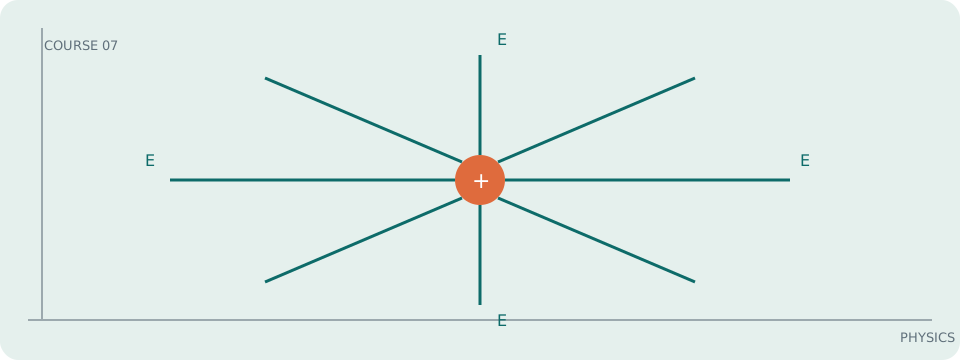
ANCHOR EQUATION
Electric field
In symbols: E = F/q
The field is force per unit charge, defined locally.
The electric field makes force local
Instead of treating one charge as reaching across empty space, define a field at each point: the force a small positive test charge would feel per unit charge. The test charge is imagined small enough not to disturb the source.
Divide out the test charge
For a test charge q in force F, define E = F/q. Substituting Coulomb’s law for source charge Q gives E = kQ/r² r̂. For several sources, forces add, so fields add vectorially: E_total = ΣE_i. A negative test charge feels force opposite the field direction.
A +5 nC source 0.10 m away produces E = 8.99×10⁹(5×10⁻⁹)/0.01 = 4495 N/C. A −2 nC test charge then feels F = qE = −8.99 μN, toward the source.
Field and force are different quantities
E exists at a point even if no test charge is placed there; F depends on the chosen q. Field-line density is a visualization, not a direct count of lines in space.
Work it: Two equal + charges sit at x = ±0.10 m. Find E at the origin and at x = 0.20 m. Use vector directions, not just magnitudes.