07 / CHAPTER 01
Charge and Coulomb’s law
Model electric interaction and its inverse-square structure.
ANCHOR EQUATION
Coulomb’s law
In symbols: F = kq₁q₂/r²
The inverse-square electrostatic force between two point charges.
Charge is the source of electric interaction
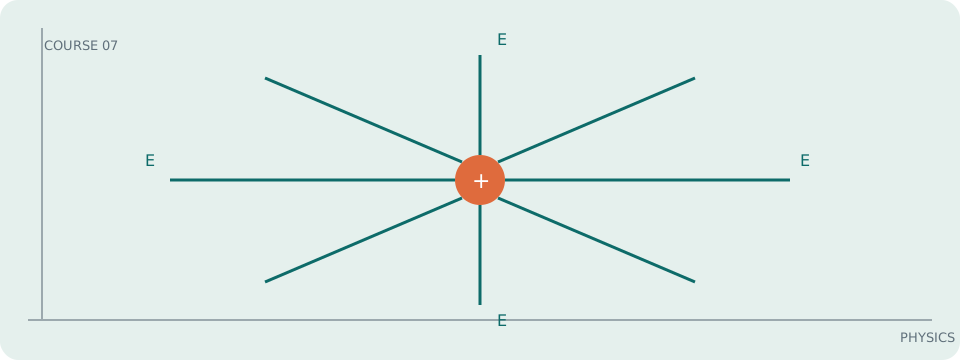
Electric charge is a conserved property that produces and responds to electric fields. Like charges repel, unlike charges attract, and the inverse-square law reflects geometric spreading of the field from a point source.
Build Coulomb’s law from symmetry
For point charges q₁ and q₂ separated by r, spherical symmetry and experiment give force magnitude proportional to q₁q₂/r². In SI, F = k|q₁q₂|/r² with k = 1/(4πε₀). The direction lies along the line joining charges; the sign of q₁q₂ selects attraction or repulsion.
Two charges 2 μC and −3 μC separated by 0.20 m have force magnitude F = 8.99×10⁹(6×10⁻¹²)/0.04 = 1.35 N, attractive. The microcoulomb conversion is essential: 10⁻⁶ C.
Point-charge assumptions matter
A distributed charge requires integration or symmetry arguments, and nearby materials polarize. The inverse-square form applies in vacuum or with a medium-specific permittivity under the appropriate approximation.
Work it: Place +1 μC and +4 μC 0.30 m apart. Find the force magnitude on each and explain the opposite directions using the third law.