04 / CHAPTER 08
Gyroscopes and precession
Explain slow axis motion without confusing it with ordinary spin.
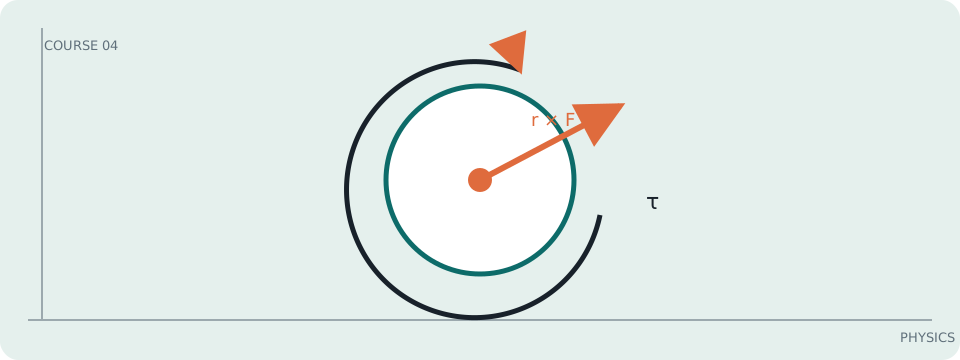
ANCHOR EQUATION
Precession
In symbols: τ = dL/dt
A torque can redirect angular momentum without changing its magnitude much.
Precession is torque perpendicular to angular momentum
A gyroscope’s spin angular momentum points along its axle. A perpendicular torque changes the direction of that vector, so the axle can sweep slowly around vertical without the spin rate changing much.
Rotate L instead of shrinking it
For steady precession at rate Ω, the angular-momentum direction changes at rate dL/dt ≈ ΩL sinθ. Gravity supplies torque τ ≈ M g r sinθ. Equating and cancelling sinθ gives Ω ≈ Mgr/L. For a fast rotor L = Iω, so Ω ≈ Mgr/(Iω).
If Mgr = 0.20 N·m and L = 0.50 kg·m²/s, Ω ≈ 0.40 rad/s, much slower than a spin of 100 rad/s. Increasing rotor spin increases L and slows precession.
The steady formula has conditions
The estimate assumes fast spin, small nutation, a fixed support geometry, and torque mainly from gravity. Startup wobble and bearing friction require a fuller rigid-body treatment.
Work it: Double the spin angular momentum in the example while keeping M, g, and r fixed. Predict precession rate and explain the vector reason rather than only quoting the inverse relation.