04 / CHAPTER 07
Angular momentum
Track rotational motion when torque is absent or organized.
ANCHOR EQUATION
Angular momentum
In symbols: L = Iω
For a rigid body about a fixed principal axis, angular momentum is proportional to spin.
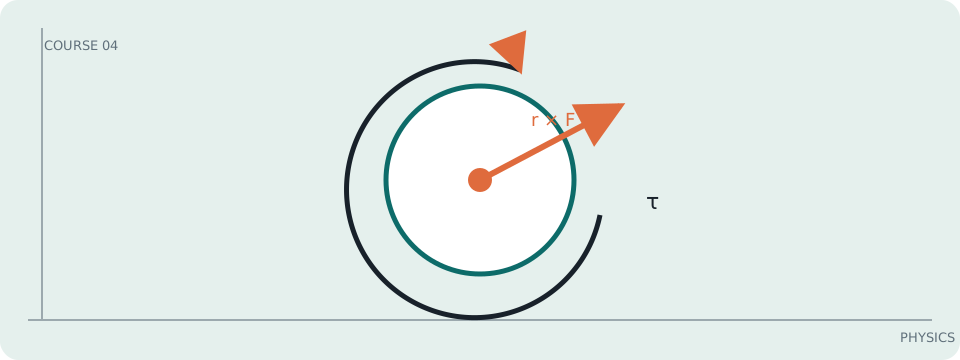
Torque changes angular momentum
Angular momentum is the rotational form of momentum. It is conserved when external torque about the chosen origin is zero, even when a body changes shape or moves closer to the axis.
Integrate the torque law
With L = Iω for a rigid body about a fixed axis and τ = Iα, τ = I dω/dt = d(Iω)/dt when I is constant. More generally, angular momentum obeys dL/dt = τ_ext. Zero external torque therefore gives constant L, not necessarily constant ω if I changes.
A skater reduces I from 4 to 2 kg·m² while initially spinning at 3 rad/s. L = 12 kg·m²/s remains fixed, so final ω = 12/2 = 6 rad/s. Rotational kinetic energy rises because internal work changes the configuration.
Conservation depends on the origin and external torque
A shaft bearing can exert torque about the center, breaking angular-momentum conservation for the rotor alone. Include the bearing or measure its torque if the ideal model fails.
Work it: A turntable with I = 5 kg·m² spins at 2 rad/s. A person steps on and increases I to 8 kg·m². Predict the new speed and compare rotational energies.