09 / CHAPTER 09
Elastic solids
Relate stress and strain in a recoverable material model.
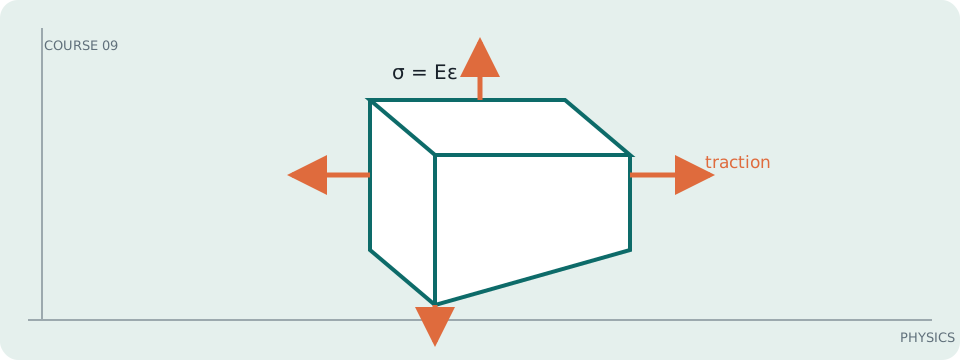
ANCHOR EQUATION
Hooke’s law
In symbols: σ = Eε
The simplest recoverable solid model links stress and strain linearly.
Elastic stress is proportional strain only in a regime
An elastic material returns energy on unloading, and a linear elastic model says small stress produces proportional small strain. The proportionality constant depends on the loading mode and material.
Use energy and geometry
For uniaxial loading, stress σ = F/A and strain ε = ΔL/L. Hooke’s law sets σ = Eε, so ΔL = FL/(AE). The elastic energy density is ∫₀^ε σ dε = ½Eε²; multiplying by volume gives stored strain energy.
A steel bar with E = 200 GPa, F = 10 kN, L = 1 m, A = 100 mm² has σ = 100 MPa and ε = 5×10⁻⁴. Extension is ΔL = 0.50 mm; energy is ½FΔL = 2.5 J.
Elastic and linear are different assumptions
Rubber can be elastic but highly nonlinear; metals can be linear elastic only below yield. Temperature, rate, and prior loading can alter the response.
Work it: A 2 m bar with A = 200 mm², E = 70 GPa carries 5 kN. Calculate stress, strain, extension, and stored energy; check that energy units reduce to joules.