09 / CHAPTER 08
Constitutive laws
Separate universal balances from material-specific behavior.
ANCHOR EQUATION
Constitutive split
In symbols: response = law + state
Balances are universal; constitutive laws encode material behavior.
Balances are universal; constitutive laws close the problem
Conservation laws say what must balance but not how a material responds. A constitutive law supplies the missing relation between stress, strain, temperature, and history.
Count unknowns and equations
Mass and momentum balances contain fields ρ, u, and σ. Without a relation for σ, many solutions satisfy the balances. For a linear elastic solid, σ = C:ε; for a Newtonian fluid, viscous stress depends on rate of deformation. The model is therefore balances plus constitutive law plus initial and boundary conditions.
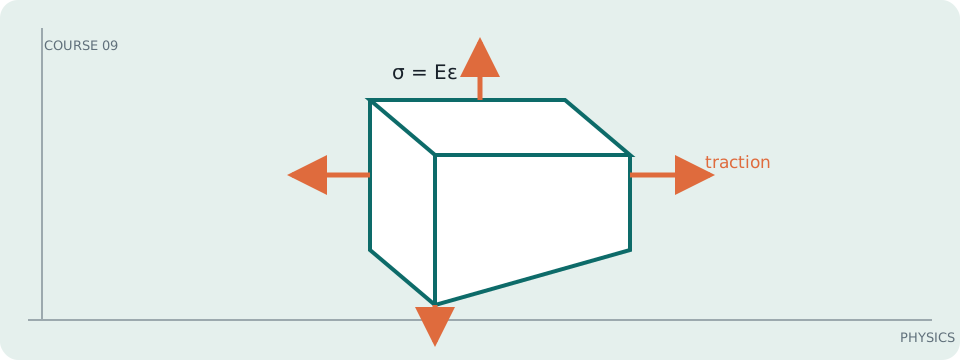
A 1D bar with constant area A has equilibrium dσ/dx = 0, so σ is constant. To predict extension, one still needs σ = Eε and ε = du/dx; then u(x) is determined by boundary displacement.
A constitutive law has a domain of validity
Hooke’s law fails after yield; Newtonian viscosity fails for non-Newtonian fluids; memory materials require history variables. A fitted law should be tested outside the calibration point.
Work it: List unknowns and equations for steady 1D viscous flow with velocity u(y), pressure gradient dp/dx, and viscosity μ. Identify which relation closes the momentum balance.