09 / CHAPTER 02
Deformation and displacement
Describe how a body changes shape in space.
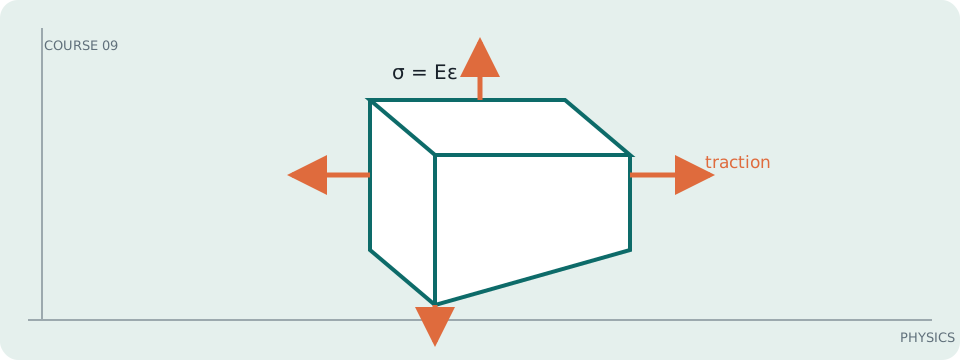
ANCHOR EQUATION
Small strain
In symbols: ε = ½(∇u + ∇uᵀ)
The symmetric displacement gradient measures small deformation without rigid rotation.
Displacement maps material points
A solid or fluid element changes position and shape. A motion map labels a material point by its reference coordinate X and returns its current position x(X,t), separating identity from location.
Differentiate the motion map
Write x = χ(X,t). The deformation gradient F = ∂x/∂X tells how a small material vector dX becomes dx = F dX. Its determinant J = det F gives local volume ratio: J > 1 expansion, J < 1 compression. Velocity is ∂χ/∂t at fixed X.
If x = 2X in one dimension, a segment dX = 0.01 m becomes dx = 0.02 m; stretch ratio is 2. If x = X + 0.1tX, stretch grows as 1 + 0.1t.
Large rotations are not necessarily strain
A rigid body can rotate with F orthogonal and preserve lengths, so deformation measures must separate rotation from stretch. Treating displacement magnitude as strain confuses motion with shape change.
Work it: For 2D map x = 2X + Y, y = X + 2Y, form F, compute det F, and state whether area doubles, shrinks, or stays constant.