09 / CHAPTER 01
The continuum idealization
Know when replacing atoms with fields is useful and where it fails.
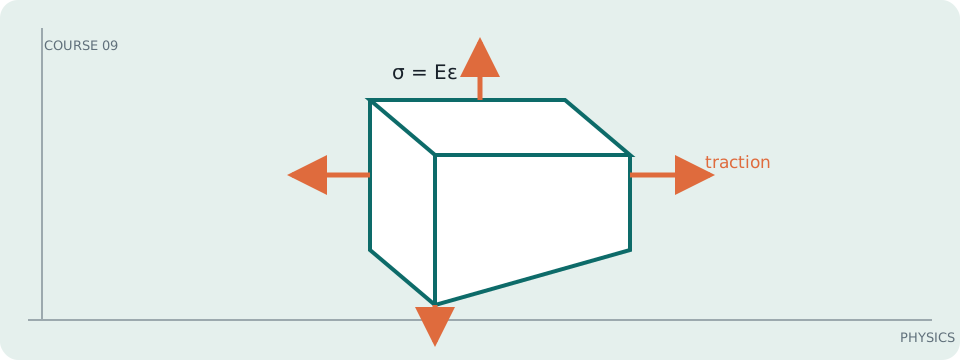
ANCHOR EQUATION
Motion map
In symbols: x = χ(X,t)
A motion map sends each material point from reference to current position.
A continuum is a resolution choice
Continuum mechanics replaces discrete atoms with fields such as density, velocity, and stress. It works when the length scale of interest is much larger than the molecular mean free path and when averaged quantities vary smoothly.
Compare scales
Let L be the device scale and ℓ the microscopic spacing or mean free path. A continuum approximation requires Kn = ℓ/L ≪ 1. Then a small volume can be large enough to contain many particles but small enough that fields are nearly uniform inside it; density is mass divided by that representative volume.
For water with molecular spacing about 0.3 nm in a 1 cm pipe, Kn ≈ 3×10⁻⁸, so a continuum density field is extremely well justified. In a rarefied chamber with L = 1 μm and ℓ = 0.1 μm, Kn = 0.1 and slip effects may matter.
Continuum does not mean incompressible
A continuum can compress, heat, fracture, or change phase. Incompressibility is a separate approximation about density or volume response.
Work it: Estimate Kn for air with mean free path 70 nm in a 1 mm channel and a 1 m channel. Predict which geometry is more sensitive to rarefaction.