05 / CHAPTER 08
Traveling and standing waves
Interpret wavelength, phase, nodes, and antinodes.
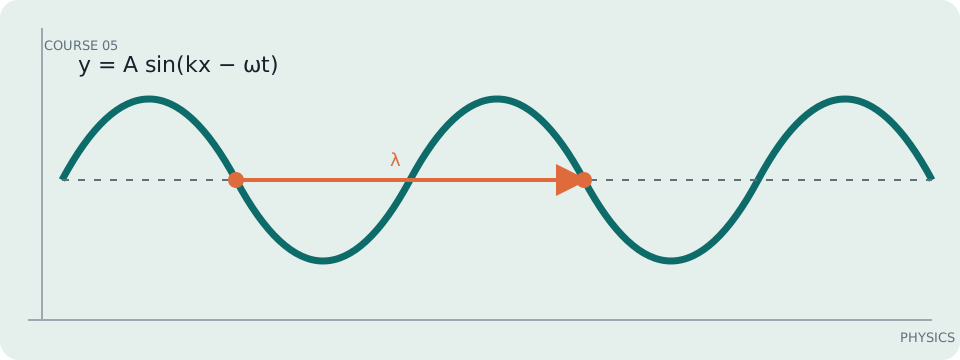
ANCHOR EQUATION
Traveling wave
In symbols: y = A sin(kx − ωt)
The phase kx − ωt moves at speed v = ω/k.
Traveling and standing waves are interference patterns
A traveling wave carries phase through space; a standing wave is the sum of waves traveling in opposite directions. Nodes are points of permanent cancellation, while antinodes oscillate with maximum amplitude.
Add two opposite waves
Take y₁ = A sin(kx − ωt) and y₂ = A sin(kx + ωt). The identity sinα + sinβ = 2 sin[(α+β)/2] cos[(α−β)/2] gives y = 2A sin(kx)cos(ωt). The spatial factor fixes nodes at sin(kx) = 0, so x = nπ/k = nλ/2.
For a 1.2 m string fixed at both ends, the fundamental has λ₁ = 2L = 2.4 m. At v = 120 m/s, f₁ = v/λ = 50 Hz; the next mode is 100 Hz with one interior node.
Boundary conditions choose allowed wavelengths
A free end and a fixed end impose different slope or displacement conditions, so the harmonic sequence changes. The standing pattern is not a material object moving from node to node; energy is exchanged locally between kinetic and potential forms.
Work it: List the first three wavelengths for a string fixed at both ends with L = 0.9 m. At v = 180 m/s, compute their frequencies and mark nodes.