05 / CHAPTER 07
The wave equation
Move from discrete oscillators to a continuous field equation.
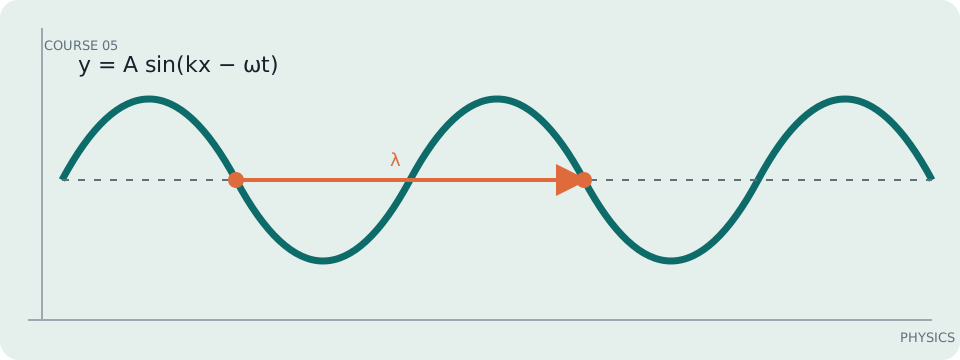
ANCHOR EQUATION
Wave equation
In symbols: ∂²y/∂t² = v²∂²y/∂x²
Local curvature in space drives local acceleration in a wave.
The wave equation is coupled local oscillation
A continuous string behaves like infinitely many small masses coupled by tension. A local bend creates a transverse force, so curvature determines local acceleration.
Take the limit of a string segment
For a segment of length Δx and tension T, the vertical force is approximately T[∂y/∂x at right − ∂y/∂x at left] = T(∂²y/∂x²)Δx. Its mass is μΔx, where μ is mass per length. Newton’s law gives μΔx y_tt = TΔx y_xx; cancel Δx to obtain y_tt = (T/μ)y_xx. Thus wave speed v = √(T/μ).
A string with T = 80 N and μ = 0.005 kg/m has v = √(16,000) = 126.5 m/s. Increasing tension speeds the wave; increasing linear density slows it.
The wave speed belongs to the medium
A source can change frequency and wavelength, but in a fixed string v stays set by T and μ, so λ = v/f changes inversely with f. Large amplitudes, bending stiffness, or variable tension break the simple model.
Work it: A 2 m string supports a 50 Hz wave at v = 100 m/s. Find wavelength. Then calculate the required tension if μ = 0.010 kg/m.