03 / CHAPTER 10
Rocket and jet momentum
Connect mass flow to thrust and control-volume thinking.
ANCHOR EQUATION
Thrust from mass flow
In symbols: T = ṁve
A jet gains momentum because mass leaves with a directed velocity.
A jet carries momentum across a boundary
Thrust is the reaction to a directed momentum flux. A nozzle can exert force even when the fluid’s pressure appears uniform because the velocity vector changes as mass exits.
Use the steady-flow momentum balance
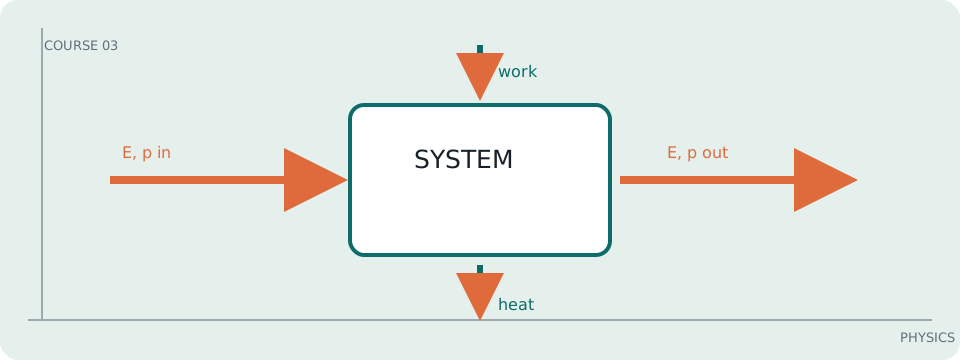
For a control volume, ΣF_ext = Σ_out ṁv − Σ_in ṁv. If one inlet is nearly stationary and one outlet carries mass at v_e, the momentum-flux term is ṁv_e. The equal-and-opposite reaction on the device is the ideal thrust, with pressure corrections added when outlet and ambient pressures differ.
A fountain nozzle sends 0.25 kg/s upward at 12 m/s from nearly stationary water. The water’s upward momentum flux is 3.0 N, so the nozzle experiences about 3.0 N downward from momentum alone. A 0.5 m² jet support would average 6 Pa of load over that area.
Mass flow and volume flow are different
ṁ = ρQ connects them. Using Q directly in a momentum equation misses a factor of density and produces units of m⁴/s² instead of newtons.
Work it: Water exits a 6 mm diameter nozzle at 18 m/s. Compute Q, ṁ, and the momentum reaction. Use ρ = 1000 kg/m³ and show the unit chain.