03 / CHAPTER 09
Collisions
Separate momentum conservation from kinetic-energy conservation.
ANCHOR EQUATION
Momentum conservation
In symbols: Σpbefore = Σpafter
Internal forces cancel in the total momentum balance of an isolated system.
Momentum survives collisions more reliably than kinetic energy
In an isolated collision, total momentum is conserved because internal impulses cancel. Kinetic energy is conserved only in an elastic collision; deformation, sound, and heat can move it into other forms.
Add momenta before and after
For two bodies, p₁i + p₂i = p₁f + p₂f. In a perfectly inelastic collision they stick, so (m₁v₁ + m₂v₂) = (m₁ + m₂)v_f. Kinetic-energy loss is K_i − K_f and is nonnegative for the sticking model.
A 2 kg cart at 3 m/s hits a 1 kg cart at rest and sticks. v_f = 6/3 = 2 m/s. Initial K = 9 J; final K = ½(3)(4) = 6 J, so 3 J became deformation, sound, or heat.
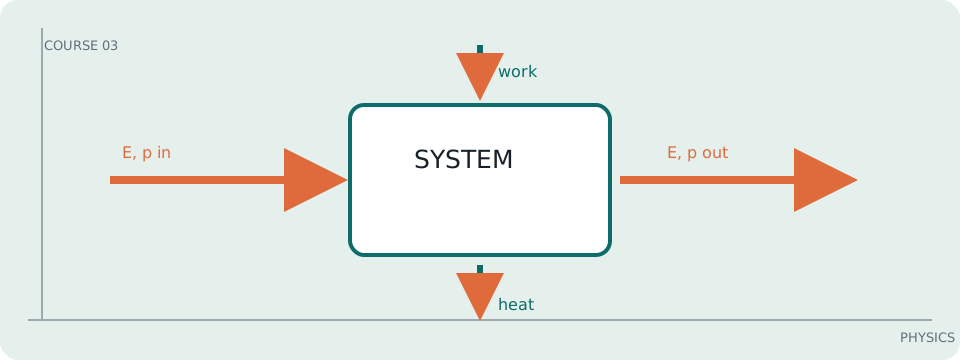
The system boundary controls conservation
External impulse during a collision, such as a wall force, prevents momentum conservation for the colliding objects alone. Include Earth or use a short enough interval that external impulse is negligible.
Work it: A 0.50 kg cart moving +4 m/s collides elastically head-on with a 1.0 kg cart at −1 m/s. Solve the two momentum and kinetic-energy equations for both final velocities.