09 / CHAPTER 06
Balance of linear momentum
Derive the continuum force balance from a control volume.
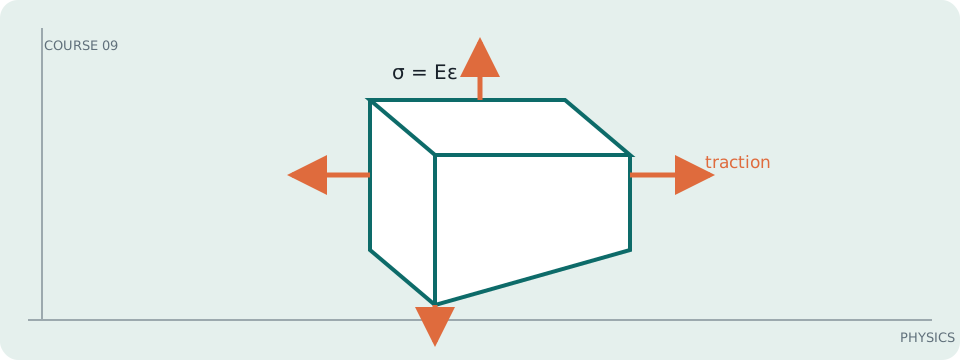
ANCHOR EQUATION
Momentum balance
In symbols: ρDu/Dt = ∇·σ + ρb
Local linear momentum balance for a continuum.
Momentum balance turns forces into stress divergence
A continuum’s local acceleration comes from surface forces, body forces, and mass density. Stress divergence is the net surface-force density left after neighboring tractions nearly cancel.
Shrink a momentum control volume
For a fixed volume, accumulation of ρu equals surface traction flux plus body force. Using t(n) = σ·n and the divergence theorem gives ρ Du/Dt = ∇·σ + ρb, where b is body force per mass. Each term has units N/m³: density times acceleration, stress gradient, and body-force density.
In one dimension with σ_xx = 2000x Pa and ρ = 1000 kg/m³, ∂σ_xx/∂x = 2000 N/m³, giving acceleration 2 m/s² if body force is absent.
Stress divergence is a gradient, not stress itself
Uniform stress can be large yet produce zero net acceleration in the bulk because equal tractions act on opposite faces. Boundary tractions can still support the body.
Work it: For σ_xx = 4x² kPa and ρ = 800 kg/m³, calculate acceleration at x = 0.5 m. Add body force b = −9.81 m/s² and interpret the result.