09 / CHAPTER 04
Traction and the stress tensor
Represent internal force across arbitrary planes.
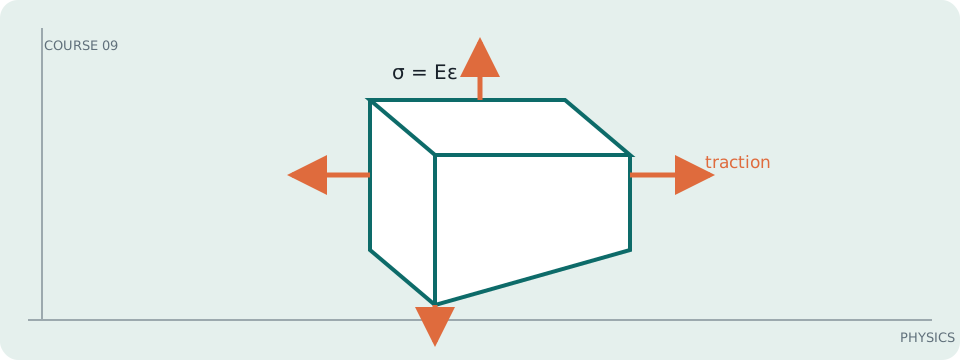
ANCHOR EQUATION
Traction
In symbols: t(n) = σ·n
The stress tensor predicts force per area on an oriented plane.
Traction is force density on an oriented plane
Internal forces are not one scalar pressure in a general solid; the force per area depends on the plane’s orientation. The stress tensor stores this directional information.
Cut a body and take the limit
Cut a small area ΔA with unit normal n. The neighboring material exerts force ΔF on the cut; traction is t(n) = lim ΔF/ΔA. Cauchy’s theorem shows t(n) = σ·n, where σ is a second-order tensor. Its normal component changes length; tangential components shear.
For σ = diag(100, 50, 0) kPa and a plane normal n = (1,0,0), traction is (100,0,0) kPa. The normal stress is 100 kPa. A tilted plane mixes components through matrix multiplication.
Stress is not pressure in a solid
Pressure is isotropic compression, σ = −pI. Shear stress, tension, and anisotropy require the full tensor; reporting only a scalar can hide the failure mode.
Work it: Use σ = [[80,20],[20,40]] kPa and n = (0,1). Find traction. Repeat for n = (1,1)/√2 and separate normal and tangential parts.