07 / CHAPTER 10
Faraday’s law and induction
Explain generators, transformers, and back EMF.
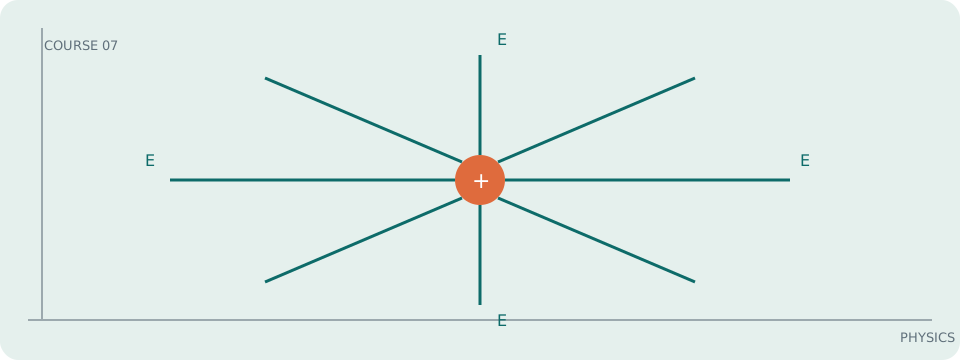
ANCHOR EQUATION
Faraday’s law
In symbols: ∮E·dl = −dΦB/dt
Changing magnetic flux induces an electric field.
Ampère and Biot–Savart encode current geometry
Moving charge creates magnetic field whose direction follows the right-hand rule. Biot–Savart integrates contributions from current elements; Ampère’s law is a shortcut when symmetry makes the circulation simple.
Choose the integral that matches symmetry
Biot–Savart gives dB = (μ₀/4π) I dℓ × r̂/r². For an infinite straight wire, cylindrical symmetry makes B constant on a circle: ∮B·dl = B(2πr) = μ₀I, so B = μ₀I/(2πr). The 1/r falloff differs from a point electric charge because the source is an extended line.
A 5 A wire at r = 0.02 m produces B = (4π×10⁻⁷)(5)/(2π·0.02) = 50 μT. Doubling distance halves the field.
Symmetry is the shortcut’s price
Ampère’s loop can always be written, but B may vary in magnitude or direction along it, preventing the simple B·length extraction. Use Biot–Savart or numerical integration then.
Work it: Two parallel wires carry 4 A in the same direction 0.05 m apart. Calculate force per length μ₀I₁I₂/(2πd) and decide attraction or repulsion.