07 / CHAPTER 07
Kirchhoff’s laws and transients
Solve networks and first-order RC/RL behavior.
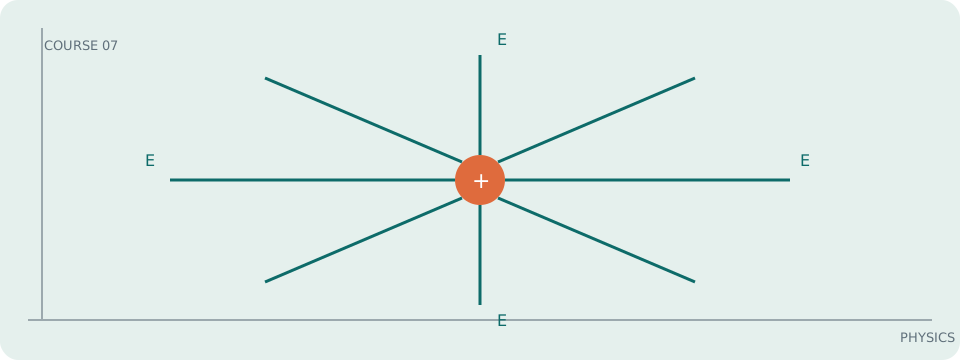
ANCHOR EQUATION
Kirchhoff current law
In symbols: ΣIin = ΣIout
Charge conservation at a node.
Kirchhoff laws are conservation statements
Circuit nodes conserve charge; loops conserve energy. These laws let local voltage and current measurements constrain an entire network without pretending current is consumed by a resistor.
Write node and loop equations
At a node, charge cannot accumulate in steady state, so ΣI_in = ΣI_out. Around a closed loop, the net potential change is zero: ΣΔV = 0. For a resistor, ΔV = IR; combine this relation with the two conservation laws to solve unknown currents.
A 12 V source feeds two parallel resistors 6 Ω and 3 Ω. Currents are 2 A and 4 A; source current is 6 A. Power checks: 12(6) = 72 W, equal to 2²(6) + 4²(3) = 72 W.
Transient circuits store energy
The steady node law remains, but capacitor charge and inductor flux can change with time. Then currents may differ at a node only if charge accumulation is included: ΣI = dQ_node/dt.
Work it: Solve a 10 V source with a 2 Ω resistor in series with a parallel 4 Ω and 8 Ω branch. Find total current, branch currents, and verify power balance.