03 / CHAPTER 04
Conservation of mechanical energy
Solve motion from energy differences and state what breaks conservation.
ANCHOR EQUATION
Mechanical energy
In symbols: K + U = constant
Energy conservation is a model choice with assumptions that must be stated.
Mechanical energy is conserved only after naming losses
The useful conservation statement is K + U = constant when only conservative forces do work. If friction, drag, or an engine transfers energy across the chosen boundary, add those transfers instead of declaring energy ‘lost.’
Put every work term on one side
The work theorem says ΔK = W_cons + W_noncons. For conservative forces W_cons = −ΔU, so ΔK + ΔU = W_noncons. If W_noncons = 0, K₂ + U₂ = K₁ + U₁. This derivation shows exactly where a friction term enters and prevents accidental double counting.
A 0.50 kg ball drops 4 m from rest with 6 J of air-drag work. Initial U = 0.5(9.81)(4) = 19.6 J; final K = 19.6 − 6 = 13.6 J; v = √(2K/m) = 7.37 m/s, below the 8.86 m/s vacuum speed.
Choose the boundary before auditing energy
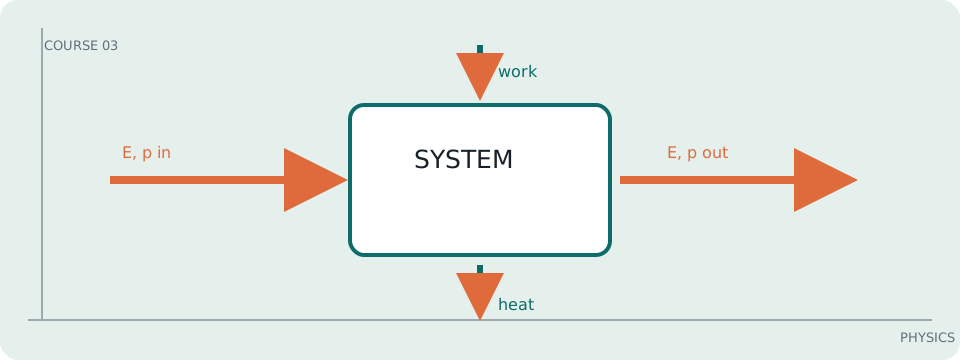
If the system includes the floor, impact deformation can remain internal energy; if it includes only the ball, the same energy crosses the boundary as work. Conservation never fails, but a narrow mechanical model can omit an energy store.
Work it: A 2 kg sled starts at height 5 m and reaches height 2 m with speed 4 m/s. Calculate the nonconservative work and decide whether it was positive or negative.