03 / CHAPTER 01
Work as energy transfer
Calculate mechanical work and track its sign across a path.
ANCHOR EQUATION
Work
In symbols: W = ∫F·dr
Work accumulates the component of force along the path.
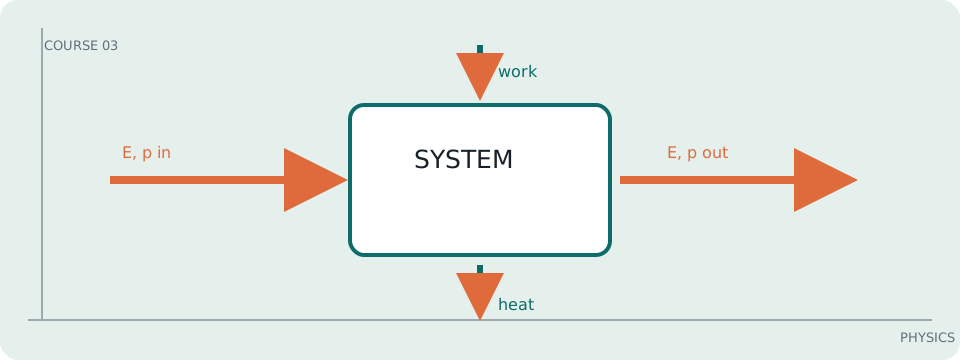
Work is directed energy transfer
A force transfers mechanical energy only through the component parallel to displacement. A perpendicular force can be large and do no work, as the inward force does in uniform circular motion.
Accumulate tiny transfers
Over a small displacement dr, the work is dW = F·dr = F cosθ ds. Adding segments along a path gives W = ∫ F·dr. The dot product selects the component along motion; its units are N·m = J. Positive work raises kinetic energy, negative work removes it.
A 20 N force acts at 60° while a crate moves 3 m. Constant-force work is W = 20(3)cos60° = 30 J. If the force is perpendicular, W = 0 even though it changes the path or direction.
Path dependence is a physical diagnostic
If force varies or points differently along the path, the integral must be evaluated segment by segment. Conservative forces have path-independent work; friction generally does not because the path length changes the energy dissipated.
Work it: A 10 N force changes from parallel to perpendicular over a 2 m quarter-circle path. Sketch F·dr and estimate the work if the tangential component is F cosφ with φ equal to the swept angle.